

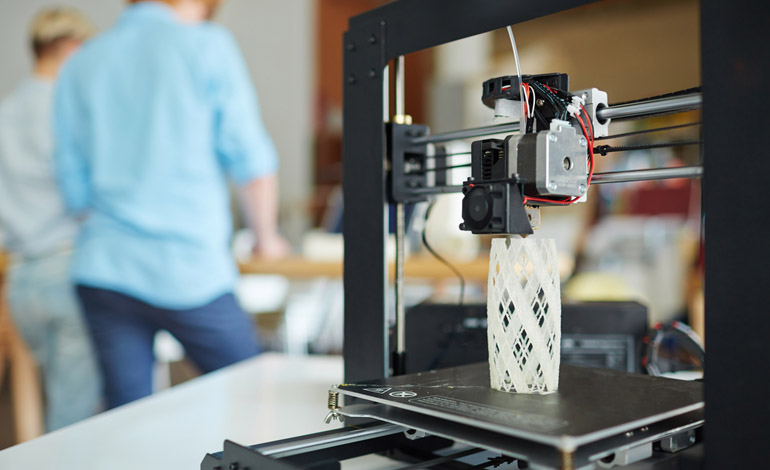

In the latest “new blockchain use cases” story, we talk about 3D-TOKEN, a project of Italy’s Politronica Srl startup that wants to integrate 3D printers all around the world into a decentralized network.
As you may have heard, the 3D printing technology has been advancing in the last few years, and now it’s more affordable than ever to print something in 3D. According to the Wohlers Report 2016, there were more than 278,000 desktop 3D printers — those costing under $5,000 — in the world in 2015. Heck, there were stories of entire houses being built with huge 3D printers in 24 hours.
But they all work separately…
Connecting the dots
Politronica Srl, which is a spin-off of the Italian University “Politecnico di Torino,” aims to connect all those printers and create what it calls a “one of a kind” decentralized Just-In-Time Factory 4.0.
Dubbed “Network Robots’ Workforce,” this network will be able to change the traditional industry norms on time-to-market and product cost. It is designed to function as a facilitator between different 3D manufacturing projects and could greatly reduce production costs.
At the moment, the network counts some 100 3D printers, with the goal to increase this number to 3,000 by the end of 2019 with 1,000 Network Members and a production capacity of up to 300 tons of processed bioplastics.
Politronica Srl has already managed to score a deal with the design shop chain Flying-Tiger Copenhagen, which operates 600 shops around the world. Through this collaboration, they will roll out an innovative desktop 3D printing learning device and lamp called Q3D during the upcoming months.
3D-TOKEN has its cryptocurrency
As that’s the norm with most blockchain-based projects, 3D-TOKEN has its cryptocurrency, marked as 3DT, which will be used to conduct commerce on the network. It is based on the Ethereum blockchain, and the ICO is still under way.
The 3DT tokens will be used for participating in crowdfunding campaigns, and for purchasing stuff at their internal marketplace. Also, 3DTs can be traded within the network, and everyone holding these tokens will be able to receive profits’ share from the Network.

Our take
What makes the 3D-TOKEN project interesting is that it doesn’t try to decentralize the existing business — it’s not like there is some other centralized network offering a similar service (at least I haven’t heard of it). Rather, it was envisioned from the ground-up to “work in a blockchain” and to ride this huge tide. And because it’s based on Ethereum, 3D-TOKEN gets to benefit from the solid infrastructure right from the get-go.
We’ll be watching this story closely, and get back to you as soon as we hear something new. Stay tuned in the meantime.