


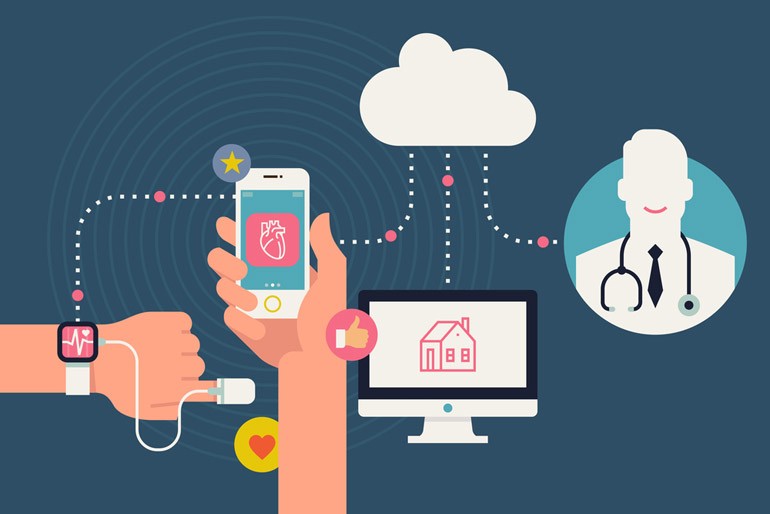

You may have heard how your smartphone could make you healthier. It could – with its built-in GPS and some app, you get an activity tracker that can measure your walks, runs and bike rides, among other things.
But that’s just a start, as you can use other products that connect to the smartphone to further improve your well-being. Yes, we are talking about wearable devices — also known as wearables — but NOT ONLY about them.
There is a number of different digital health devices that are already available to the general public; these mHealth devices either connect to a smartphone — typically via Bluetooth — or have their own cellular connectivity (not as often).
Here we’ll present you with few different mHealth device types you can buy today.
1. Fitness Bands & Sport Watches


These devices are made to keep up with one’s fitness activity. Some — as in more expensive models — integrate a heart rate sensor, while some other lack this capability. Some fitness bands are water resistant, and some can go beyond basic exercise activities like walking, running and cycling to also include swimming to the mix, as well as other exercise types and sport activities. Here are the best of the bunch:
- Fitbit Charge 2 HR – integrates a heart rate sensor. It sings along Fitbit’s amazing fitness/wellness platform and apps, and is available in a few different colors.
- Fitbit Flex 2 – a simpler model that is waterproof and can, thus be used to track swimming.
- Garmin vivofit 3 and Garmin vívosmart HR+ – Garmin’s pair of wearables is as powerful as Fitbit’s products thought their platform isn’t as comprehensive.
- Misfit Shine and Misfit Ray – both fancy and waterproof. Also, small and easy to carry/wear around.
- Mira Wellness and Activity Bracelet – a bracelet shaped activity tracker ladies will love.
- UP3 by Jawbone – Jawbone’s best-ever activity tracker with built-in heart rate monitor. Also very fancy.
- Samsung Gear IconX Cordfree Fitness Earbuds with Activity Tracker – these wireless headphones can track your fitness. Pretty cool.
Sports Watches
- Samsung Gear Fit2 – as fancy as an activity tracker can be with big screen that instantly show stats.
- Withings Activité Sapphire, Activité Pop and Activité Steel – these three look like regular watches everyone, not just fitness enthusiasts, would want to wear.
- Fitbit Blaze – Fitbit’s best-ever fitness tracker is a sports watch with a number of options and smart features.
- Garmin vívoactive HR – And this is Garmin’s version with big color screen.
2. Smart Watches
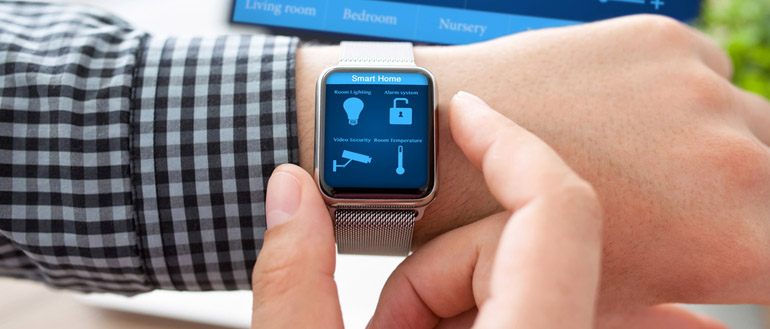
Smart watches such as Apple Watch, Samsung Gear S3, and devices running Google’s Android Wear platform build on top of fitness bands, adding new capabilities and big screens to the mix. This in turn makes these wearables more versatile with additional features being used to deliver notifications, information from connected apps, “at glance” views, personal assistant capabilities, maps, notes and more. These devices, however, don’t have long battery lives and more often than not, require charging on a daily basis. Something’s gotta give, I guess.
- Apple 42mm Watch and Apple 38mm Watch – If you have the iPhone, you’ll want the Apple Watch. Just pick the size that fits your wrist.
- Huawei Watch – the best Android Wear smartwatch. Period. It’s fancy, it’s smart and you’ll love it.
- Samsung Gear S2 – Samsung’s smart watch runs the company’s own Tizen platform that offers a number of apps. In addition to the sport version, there’s also the classic one.
- Motorola Moto 360 Sport – Moto’s fancy smart watch runs Google’s Android Wear platform and even has a built-in GPS.
3. Connected Scales
Connected/Smart Scales connect to a smartphone or tablet from where they are controlled with a companion app. Beyond simple weight readouts, the information these scales gather can be synced with other apps and platforms such as Apple Health and Google Fit to provide a more comprehensive view on one’s health and wellbeing. Also, multiple users can use these products as they can automatically distinct between different family members.
- Fitbit Aria – best if you already “live in Fitbit’s ecosystem.”
- Withings WS-50 Smart Body Analyzer and Withings Body Cardio – Withings, now part of Nokia, makes excellent connected health products.
- Philips Connected Body Analysis Weight Scale – Philips’ take on a connected scale.
Also noted: Garmin index Smart Scale, QardioBase, and Polar Balance.
4. Smart Blood Pressure Cuffs

Smart blood pressure cuffs connect to a mobile device to record one’s blood pressure. Beyond one-off readouts, the companion apps to these devices provide additional information, enabling users to easily see their blood pressure history and sync that information with other apps and services where multiple health data points are stored. Also provided are useful heart health information and tips on how to stay healthy.
- Withings Wireless Blood Pressure Monitor – arguably the best known connected blood pressure monitor.
- iHealth Feel Wireless Blood Pressure Monitor – like Withings, iHealth is also known for making great connected health products.
- Omron 10 Series Wireless Upper Arm Blood Pressure Monitor with Cuff – these guys have been making blood pressure monitors for decades.
Also noted: QardioArm Wireless Blood Pressure Monitor and Philips WirelessUpper Arm Blood Pressure Monitor.
5. Sleep Monitoring Devices

According to Centers for Disease Control and Prevention (CDC), more than one-quarter of the U.S. population report occasionally not getting enough sleep, while nearly 10% experience chronic insomnia. The CDC even called insufficient sleep a public health epidemic. Sleep monitoring devices can help you get a better night sleep. Beyond pure monitoring of your sleep, these devices — together with a companion app — will provide you with actionable advice on how to get some well-needed rest.
- Sleep Shepherd – this smart beanie incorporates some fancy technology to put you in the “sleep mode.”
- Beddit 2.0 Smart Sleep Tracker – features an ultra-thin film sensor that’s placed under the bed sheet to track your sleep.
- Withings Aura – Smart Sleep System – a contact-free sleep sensor, plus an active light and sound bedside device.
- Sense with Voice Sleep System – a sleep improvement solution that can track one’s sleep behavior, monitor the environment of a bedroom, as well as provide a new twist to the alarm clock.
- Eight Sleep Tracker – an innovative mattress cover that turns any bed into a smart bed, helping users get a better night’s sleep.
- S+ By ResMed Personal Sleep Solution – uses patented bio-motion sensors to measure an individual’s sleep stages and environment, and deliver feedback that helps improve sleep from the very first night.
6. Connected Thermometers

These devices send readings via Wi-Fi or Bluetooth to a connected smartphone or tablet, where a companion app enables users to better control and manage fever episodes for multiple users. Typically that app also provides contextual information associated with readings, such as logging symptoms or making notes of any administered medicines, while enabling users to share the data with family members and, if needed, doctors.
- Withings Thermo – with its 16 infrared sensors, Thermo provides a medically-approved measurement in 2 seconds while also synchronizing with a companion smartphone app to help manage fever episodes.
- Kinsa Smart Stick Digital Thermometer and Kinsa Digital Smart Ear Thermometer – the former is best used for adults and the latter for kids and babies.
- Vicks Smart Temp Wireless Digital Thermometer – the famous thermometer maker has a smart device of its own.
- TempTraq – a sensor-laden patch that is placed under the arm and continuously senses, records and transmits temperature information to a smartphone or tablet.
- Philips Connected Digital Ear Thermometer – it is only natural that Philips has a smart thermometer of its own, right?
7. Smart Glucometers
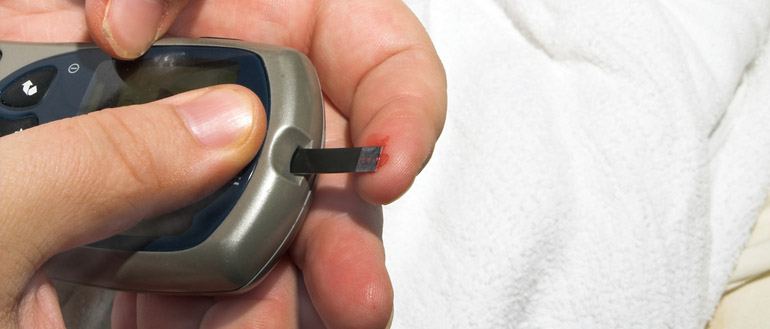
Diabetes is a disease that permeates every aspect of one’s life and these smart devices do their best to change that. With a connected glucometer and its companion app, diabetes management is better and more efficient. Let modern technology handle those little things so you can focus on the bigger goals.
- iHealth Wireless Smart Gluco-Monitoring System – Bluetooth-enabled connected glucometer.
- iHealth Align Glucometer – and the one that is placed in the 3.5mm headset jack (so it won’t work out of box with the iPhone 7)
- Lepu Smart Blood Glucose Meter Poctor 880 – another connected glucometer that is placed in a 3.5mm headset jack.
And more…
Beyond the mentioned mHealth device types, there are other products, such as smart inhalers, though most of them are not available over-the-counter to the general public. Also, many other cool devices are in development as we speak.
That being said, we are in the midst of the big wave of consumerization of healthcare that will put patients in the center of everything. Modern smart/connected devices will play a pivotal role in that new world, helping people live longer and healthier lives. In the meantime, you can already grab yourself a product that will get you closer to that goal. What are you waiting for?