



Fujitsu Laboratories has recently announced “ConnectionChain,” its newly developed security technology that can easily execute exchanges and payments in different virtual currencies. Such technology, the company claims, provides a reliable and transparent way to handle the currency exchange processing at the boundaries between the blockchains.
The issues ConnectionChain aims to solve
Blockchain is known for being resistant to modifications, offering high usability and guaranteed reliability, and is therefore expected to be used in a number of fields, including finance and distribution.
However, when there is a need to include other blockchains to the process, like during ICOs, some problems do arise. This is mainly due to the fact that existing smart contracts operate only within the limited scope of a single blockchain. And so, companies are facing two major issues when executing exchanges across multiple blockchains, including:
- The need to ensure transparency in the application located between the blockchains, which handles the processing for things like the exchange rate and handling fees.
- The need to control transaction timing across multiple blockchains, and to deal with them as a single continuous series.
And so the idea for ConnectionChain was born.
What is ConnectionChain all about?
As its name says, ConnectionChain is a connection-type chain security technology that can safely and easily execute payments between different virtual currencies. Its features are as follows:
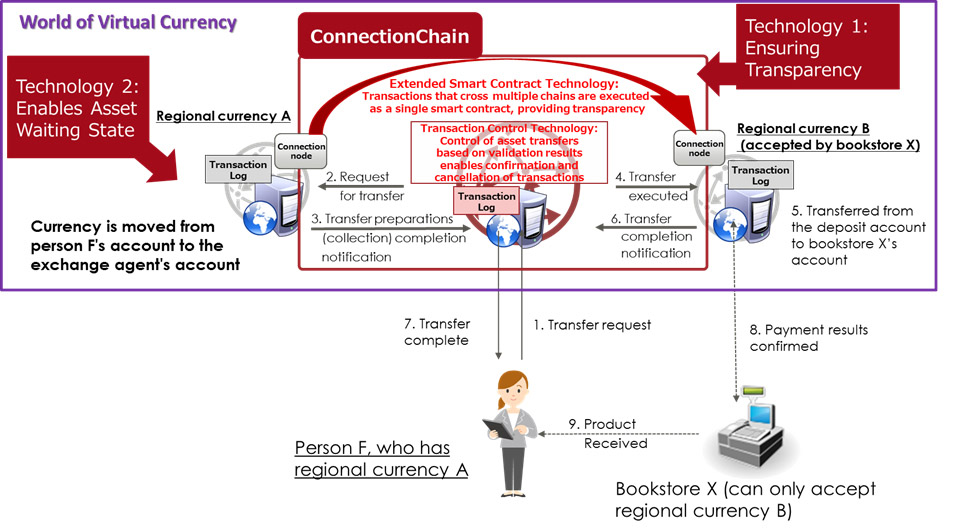

1. Extended Smart contract technology
Fujitsu’s solution enhances the capability of smart contracts, which automate contract processing and the handling of such tasks as placing orders and payments, to also be able to handle processes involving multiple blockchains. This is done by adding new nodes to connect blockchains, forming ConnectionChain, which is a new blockchain used for connecting blockchains. The block data containing the relevant transaction process is extracted from the two blockchains via this connection node, and each transaction process is connected. This enables the entire series of transactions, including task processing on the ConnectionChain, to be automatically executed as a single smart contract. Also, with such setup, operators can ensure the transparency and confirm the accuracy of the processing.
2. Transaction control technology
Fujitsu has also developed technology to control the transfer of assets in response to transaction processes across all blockchains that make up the system. This asset depositing concept can put asset-transfer on hold, which did not previously exist in blockchain transactions, to control the timing of the transaction processing in each chain. The system first puts the asset on hold temporarily without confirming the transaction process on the asset-holder’s side, then, after confirming the currency transfer from the recipient – it confirms the transaction status for the asset-holder, and so on. This in turn enables users to put the entire transaction process into a waiting state, which was difficult with existing blockchain technology, and then either confirm or cancel the transaction process based on the overall outcome.
First tests are promising…
In a trial that used this technology in a simulated virtual currency exchange system, Fujitsu Laboratories interconnected two blockchains using different architectures to a system for exchanging proprietary virtual currencies, and executed asset transfers by exchanging virtual currency.
The results confirmed that the transaction records — including the transaction IDs on each blockchain, the amount of assets transferred, and the results of those transactions — were recorded on ConnectionChain as a single transaction. On the other hand, if a transaction across blockchains were to fail while in progress, for reasons such as an inability to pay or settle, Fujitsu Laboratories also confirmed that the ID and timestamp for the transaction process that returned the assets on hold to their original owner was recorded.
The company says this technology will make it easy for small businesses, like small-scale online shops, which accept virtual currencies to support new regional currencies, while also enabling them to freely define exchange rates for various virtual currencies.
Future plans for ConnectionChain
Going forward, Fujitsu Laboratories wants to expand ConnectionChain beyond currency exchange to areas such as high-trust data exchanges between companies and contract automation. As part of that plan, it will be conducting trials in a variety of fields, especially in finance, with the goal of commercialization in fiscal 2018 and beyond.
As for the average folk like you and me, ConnectionChain could bring ever more secure and transparent ICOs, and that alone makes the technology awesome. Also, it may be used for other solutions we can’t envision at the moment. Too bad we’ll have to wait for another few months before ConnectionChain is released, and then I guess even more before some company embraces the technology.
Nonetheless, we like the idea of such big company as Fujitsu joining the crypto revolution, signaling the good days ahead. And that’s what Wallet Weekly is all about. 😉