


Joining the roster of those looking to put cryptocurrencies in action is the International Monetary Fund (IMF), according to the Wall Street Journal article.
The organization is exploring the different ways it could take advantage of blockchain and perhaps even launch a digital currency of its own. Any such effort, however, wouldn’t create a new Bitcoin nor Ethereum which are 100% decentralized; rather, the IMF would be the centralization factor that could, when needed, react with its massive power, and money. So in a way, any IMF-backed cryptocurrency would run contrary to the underlying principles behind Bitcoin.
Digital Special Drawing Rights?
We don’t really know what’s cooking behind IMF’s closed doors, but we can speculate, can’t we?
Perhaps they are looking to create a digital version of the Special Drawing Rights (SDR) which have the currency code XDR. These are IMF’s supplementary foreign-exchange reserve assets that represent a claim to currency held by IMF member countries for which they may be exchanged. The XDR was created in 1969 to supplement a shortfall of preferred foreign-exchange reserve assets, namely gold and the U.S. dollar.
XDRs are allocated to countries by the IMF, and unlike cryptocurrencies — they can’t be held nor used by private parties. The value of the XDR is based on a basket of key international currencies reviewed by IMF every five years. The weights assigned to each currency in the XDR basket are adjusted to take into account their current prominence in terms of international trade and national foreign exchange reserves.
In the review conducted in November 2015, the IMF decided that the Renminbi (Chinese Yuan) would be added to the basket effective October 1, 2016. From that day on, the XDR basket consists of the following five currencies: U.S. dollar – 41.73%, Euro – 30.93%, Renminbi (Chinese Yuan) – 10.92%, Japanese yen – 8.33%, and British pound – 8.09%.
XDR seems poised for digitization, don’t you think?
Christine Lagarde things governments shouldn’t ignore cryptocurrencies
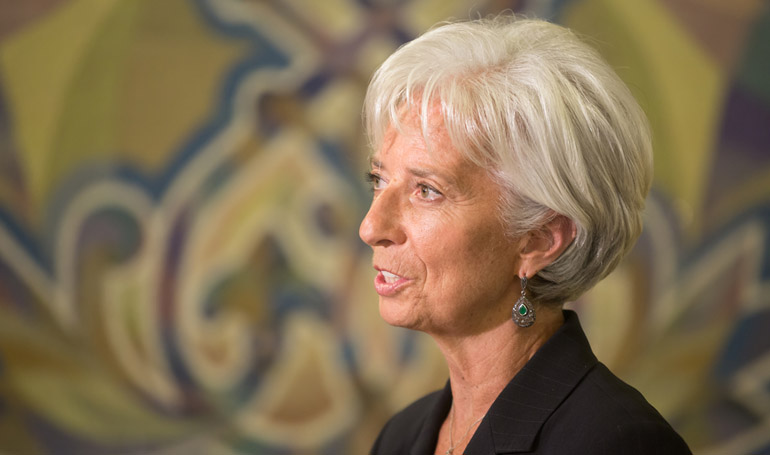
Earlier this year at a conference held in London, IMF’s chief Christine Lagarde said that virtual currencies should not be dismissed outright by governments around the world, adding that they could provide conventional government-issued tenders a “run for their money.” She added that countries with “weak institutions and unstable national currencies” may directly adopt a cryptocurrency.

Her words:
Instead of adopting the currency of another country — such as the US dollar — some of these economies might see a growing use of virtual currencies. Call it dollarization 2.0. So in many ways, virtual currencies might just give existing currencies and monetary policy a run for their money. The best response by central bankers is to continue running effective monetary policy while being open to fresh ideas and new demands, as economies evolve.
Lagarde, however, clarified that the takeover of cryptocurrencies over conventional ones is still a distant prospect. They [cryptocurrencies] are “too volatile, too risky, too energy intensive” and “the underlying technologies are not yet scalable.”
IMF believes distributed ledgers can revolutionize the financial sector
In its early 2016 staff paper, IMF considered distributed ledgers to have the capability to revolutionize the financial sector through cost reduction and deeper financial inclusion in the long term. The report placed particular focus on the rapidly growing cross-border payments industry. Also, it made recommendations on how to effectively regulate distributed ledger technology (DLT) and the digital currencies that use it.
The organization has recommended tighter know-your-customer (KYC) guidelines and regulatory oversight to prevent money laundering, tax evasion and terrorist financing. They also suggested an open discussion on balancing privacy and transparency, which could aid consumer adoption of DLT and virtual currencies.
Finally — and most importantly — IMF urged policymakers to be flexible, experimental and cooperative in dealing with the technology, encouraging governments to collaborate in the sector, while advising banks and financial institutions to adopt DLT in their operations.
With IMF’s verbal backing, we may be on the cusp of a brave new (crypto) world. What do you think?