
 Kelly Robertson
You’ve probably heard some cool stuff about ancient Egypt. We’re not here to mimic Wikipedia (though we’re using them as resource) — instead we want to point out the basics everyone should know… or so we think. In that sense, this is the list of most important information that should make you at least a bit more knowledgeable, allow you to debate with others, and so on. Without further ado, here’s what you should know:
1. Time and place
Ancient Egypt was concentrated along the lower reaches of the Nile River in what is now the modern country of Egypt. The Egyptian civilization coalesced around 3150 BC with the political unification of Upper and Lower Egypt under the first pharaoh. The history of ancient Egypt occurred in a series of stable Kingdoms, separated by periods of relative instability known as Intermediate Periods: the Old Kingdom of the Early Bronze Age, the Middle Kingdom of the Middle Bronze Age and the New Kingdom of the Late Bronze Age.
2. Pharaoh
Pharaoh was an ancient Egyptian ruler. The title originates in the term “pr-aa” which means “great house” and describes the royal palace. The title of Pharaoh started being used for the king during the New Kingdom, specifically during the middle of the eighteenth dynasty.
3. Religion
At various times certain gods became preeminent over the others, including the sun god Ra, the creator god Amun, and the mother goddess Isis. The overall system endured until the coming of Christianity in the early centuries AD.
4. Pyramids
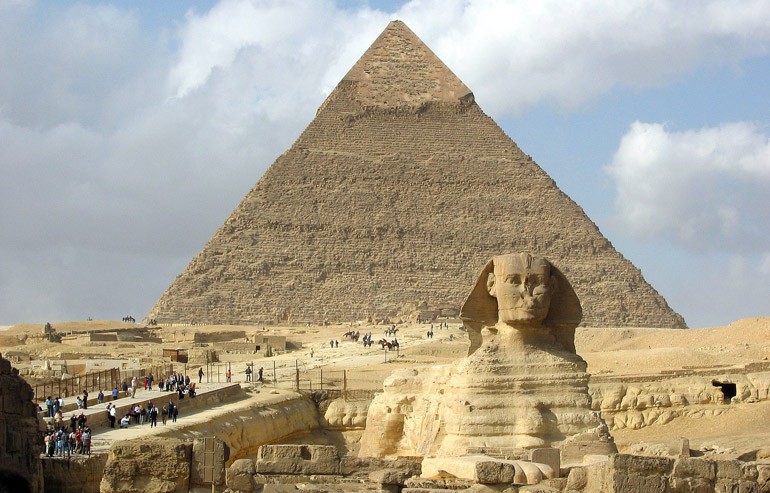
The Egyptian pyramids are ancient pyramid-shaped masonry structures located in Egypt. There are 138 pyramids discovered in the country as of 2008, most of which were built as tombs for the Pharaohs and their consorts during the Old and Middle Kingdom periods. The most famous Egyptian pyramids are those found at Giza (on the outskirts of Cairo) — the Pyramid of Khufu at Giza is the largest one and it’s the only one of the Seven Wonders of the Ancient World still in existence.
5. Sphinx
The Great Sphinx of Giza (or just Sphinx) is a limestone statue of a reclining or couchant sphinx, which is a mythical creature with a lion’s body and a human head. It stands on the Giza Plateau on the west bank of the Nile in Giza. Size wise, the Sphinx is the largest monolith statue in the world, standing 73.5 metres (241 ft) long, 6 metres (20 ft) wide, and 20.22 m (66.34 ft) high.
6. Hieroglyphs
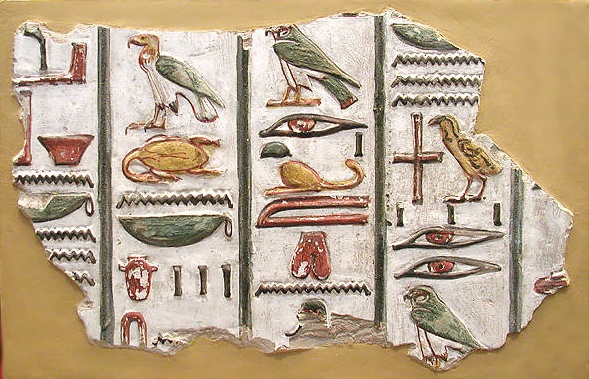
Egyptian hieroglyphs were a formal writing system used by the ancient Egyptians that combined logographic and alphabetic elements. Cursive hieroglyphs were used for religious literature on papyrus and wood…
Needless to say there’s so much more we could say about Ancient Egypt, but we believe these 6 things will get you some idea on the subject. You’re free to consult Wikipedia and any other source for that matter to get additional information. 😉
