
 Marc Serafino
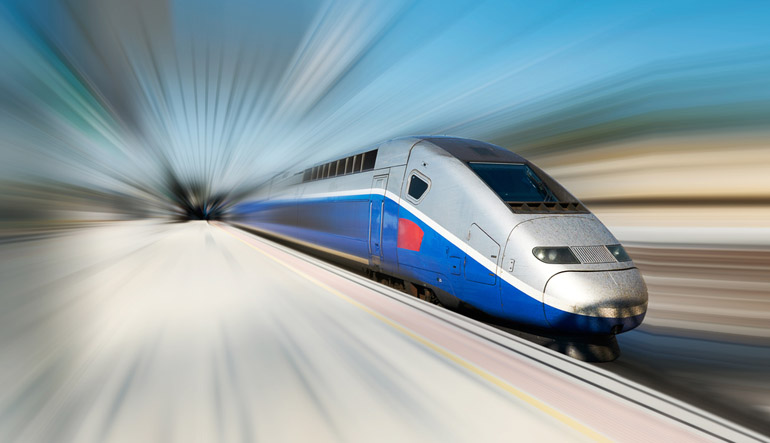
We at Wallet Weekly love trains, and if they’re fast – we love ’em even more. In this article we want to help “rail newbies” understand high-speed trains. Without further ado, here’s what you should know.
1. What is a high-speed train?
High-speed rail (HSR) is a train that operates faster than the normal speed of rail traffic. The European Union defines it as a train that operates at 200 km/h (124 mph) for upgraded track and 250 km/h (155 mph) or faster for new track. On the other hand, the U.S. Department of Transportation defines says such trains can “reach sustained speeds of more than 125 mph (201 km/h).”
2. How fast can they go?
Maximum commercial speed of high-speed trains is about 300 km/h (186 mph) for the majority of national high speed railways, and about 400 km/h (249 mph) for Maglev (magnetic levitation) trains.
The world record for conventional high-speed rail is held by the V150, a specially modified version of Alstom’s TGV which clocked 574.8 km/h (357.2 mph) on a test run. The world speed record for Maglev is held by the Japanese experimental MLX01 – 581 km/h (361 mph).
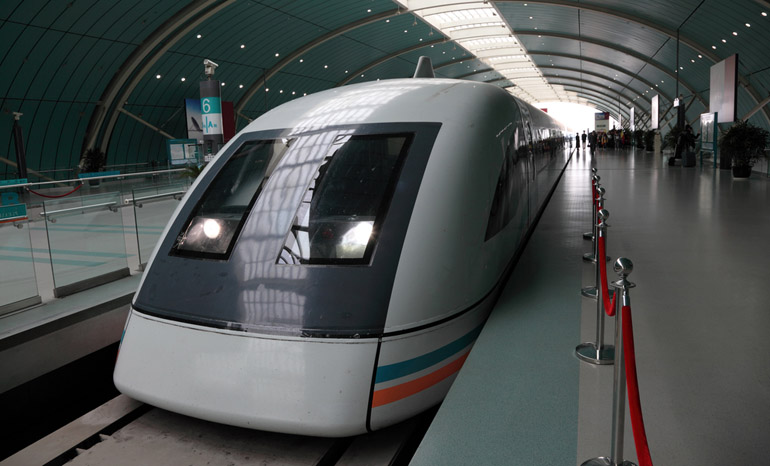
In real-life, the fastest operating conventional trains are the French TGV POS and German ICE 3 with a commercial maximum speed of 320 km/h (199 mph) on the French LGV Est. The unconventional Shanghai Maglev Train reaches 431 km/h (268 mph) during its daily service on the 30 km dedicated line between the airport and city center.
3. What’s the point?
The main idea behind the development of high-speed trains was to connect large cities. For instance, in Japan that’s Tokyo-Osaka, in Spain – Madrid–Seville (then Barcelona) and in France – Paris-Lyon. Of course, other lines followed after first ones proved as a success.
4. Why don’t just fly the plane instead?
It is said that high-speed trains are best suited for journeys of up to 4 hours when they can easily beat the air travel time. Just think about it – by taking the train you don’t have to go through security screening at airports (except if you’re travelling from Paris to London), boarding, checking-in, or go to the airport in the first place. Unlike airports, train stations are usually located near city centers.
5. What about other plus sides?
There’s comfort and convenience, both of which come from the fact that you’ll quickly arrive at your destination while being able to get up, drink and even eat something if that’s what you fancy. Moreover, rail travel has less weather dependency than air travel, making sure you’ll be travelling except in the case of extra-ordinary events like hurricanes, tsunamis or something of that nature.
6. Who makes them?
There are several companies making fast trains, including French Alstom, German Siemens (Velaro trains), Canadian Bombardier (although Bombardier Transport is headquartered in Germany), Japanese Kawasaki, Spanish CAF and few others. New entrants include China North Car (CNR) and China South Car (CSR), which used China’s large market and competition among foreign train-makers to induce technology transfers and now they’re making their own high-speed trains.
Now you’re free to check additional resources and, if you know something else you think could be interesting to our readers, share that information via the comments form below.
