
 Marc Serafino

Once you’ve bought bitcoins (or just one), you need a place to store them. This is done in bitcoin wallets, which are usually provided by the same service you used to buy bitcoins. These wallets are “made” to store the private keys that you need to access a bitcoin address and spend your funds (sign transactions). Said private keys are actually your bitcoins.
There are different kinds of bitcoin wallets, designed for different devices; actually, you can use a piece of paper to “store” your bitcoins. But I’m getting ahead of myself… Let’s look at 5 types of bitcoin wallets:
1. Desktop bitcoin wallets
The original bitcoin client, Bitcoin Core, includes the ability to create a bitcoin address for sending and receiving the virtual currency, and to store the private key for it.
There are also other options out there, such as:
- MultiBit – a multi-platform client that is available for Windows, Mac OS and Linux, and is thus popular for those who often switch from one platform to the other.
- Armory – this desktop client prides itself with enhanced security.
- DarkWallet – focused on anonymity, DarkWallet uses a browser plug-in to provide coin “mixing” which exchanges users’ coins for others’, to prevent people from tracking them.
Pretty much any of the above clients will get the job done, you’ll just want to select the one that you like the most.
2. Mobile bitcoin wallets
The obvious benefit of a mobile bitcoin wallet is that it allows you to take your bitcoins with you, no matter where you happen to go/be. These sort of wallets are also more suitable for people who want to pay for stuff with their bitcoins.

Basically, a mobile bitcoin wallet is an app running on a smartphone that stores the private keys for your bitcoin addresses, making your bitcoins available at all times. Also, some of the apps will take advantage of the smartphone’s built-in Near-Field Communication (NFC) capability (Android-only) to enable tap-to-pay functionality.
It is important to add that mobile wallets are not full-blown bitcoin clients, which have a local copy of the entire bitcoin blockchain that is multiple gigabytes in size. Rather, these apps are designed with simplified payment verification (SPV) in mind, featuring a very small subset of the blockchain, and rely on other, trusted nodes in the bitcoin network to ensure that they have the right information. Nevertheless, they “get the job done” while on the go.
Popular mobile bitcoin clients include Bitcoin Wallet (Android only), Mycelium, Xapo, Blockchain, Coinbase (also a web service) and Aegis Bitcoin Wallet.
3. Online bitcoin wallets
The most popular type — online, web-based bitcoin wallets will work without any app running on your computer or smartphone. Several such services are available, some of which also link to mobile and desktop wallets, syncing your addresses between different devices you own.
What makes web-based wallets — and other modern web services for that matter — handy is that you can access them from anywhere, on just about any device you may be using.
Arguably the most popular web-based wallet service is Coinbase, which also operates a bitcoin exchange, enabling users to both buy and store their bitcoins on their servers.
Other notable web-based bitcoin wallet services are Blockchain, Strongcoin and Xapo.
4. Hardware bitcoin wallets
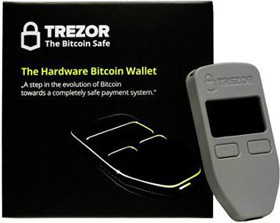 There are also less-popular, hardware bitcoin wallets, which are dedicated devices that can hold private keys electronically and facilitate payments.
Some of the better-known hardware wallets include:
- Trezor hardware wallet – made for users who want to maintain a substantial stash of coins, but do not want to rely on third-party bitcoin storage services.
- Ledger USB wallet – a relatively affordable wallet that uses smartcard security.
- Case – which enables biometrically secured multi-signature bitcoin transactions.
From what we can tell, a hardware-based bitcoin wallet is everything but a necessity, though it does look kinda cool…
5. Paper-based bitcoin wallets
Finally, you can use the good ol’ paper to store your cryptocurrency. As we noted before, storing bitcoins actually involves storing private keys for your bitcoin addresses. If you want to you can write down those private keys and have them accessible from a piece of paper. We don’t really recommend this “kind of wallet” since a single typo could mean a loss, but we had to add it here.
