
 Kelly Robertson
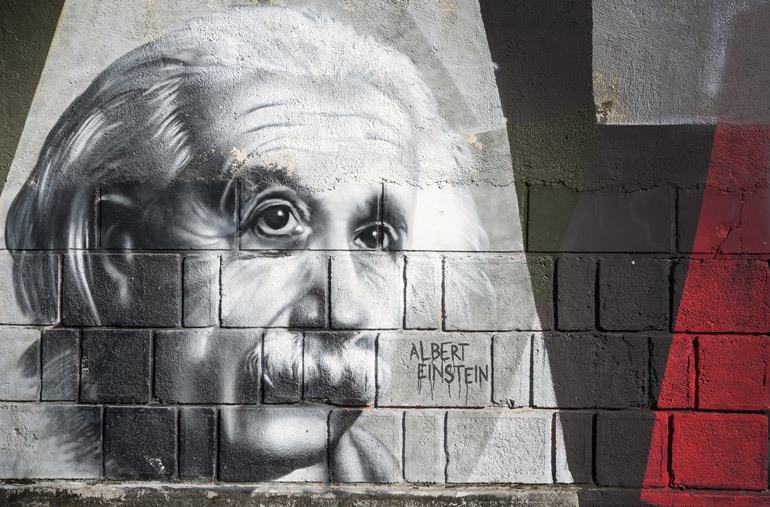
We all know about the famous physicist who developed the general theory of relativity, effecting a revolution in physics. For this achievement, Albert Einstein is often regarded as the father of modern physics and the most influential physicist of the 20th century. He received the 1921 Nobel Prize in Physics “for his services to theoretical physics, and especially for his discovery of the law of the photoelectric effect,” which was pivotal in establishing quantum theory within physics… Here are 5 things you may didn’t know about the genius.
1. Einstein had speech difficulty as a child
As a child, Einstein seldom spoke and when he did – he spoke very slowly, trying out entire sentences in his head before speaking aloud. According to accounts, he did this until he was nine years old and his parents were unsurprisingly fearful that he was retarded.
In his book, Thomas Sowell noted that besides Einstein, many brilliant people developed speech relatively late in childhood. He called this condition “The Einstein Syndrome.”
2. He failed his university entrance exam
Albert Einstein applied for early admission into the Swiss Federal Polytechnical School at the age of 17. He passed the math and science sections of the entrance exam, but failed the rest, including history, languages, geography, etc. Einstein had to go to a trade school before he retook the exam and was finally admitted to the school he wanted a year later.
3. He had an illegitimate child
Thanks to his private letters, we know Einstein had an illegitimate daughter with a fellow former student Mileva Maric, whom he later married. In 1902, a year before their marriage, Mileva gave birth to a daughter named Lieserl, whom Einstein never saw and whose fate remained unknown.
Mileva gave birth to a daughter at her parents’ home in Novi Sad, Serbia. At that time, Einstein was in Berne and it can be assumed from the content of the letters that birth was difficult. The girl was probably Christianized, though her official first name is unknown. In the letters received only the name “Lieserl” can be found.
4. Einstein was a ladies’ man
After divorcing Mileva (his infidelity was listed as one of the reasons for the split), Einstein soon married his cousin Elsa Lowenthal. Unlike his previous wife, Elsa Einstein’s main concern was to take care of her famous husband. She undoubtedly knew about and yet tolerated Einstein’s infidelity and love affairs which were later revealed in his letters.
5. After his death, Einstein’s brain was a subject of scientific research
After his death in 1955, Einstein’s brain was removed — without permission from his family — by Thomas Stoltz Harvey, the Princeton Hospital pathologist who conducted the autopsy. Harvey took the brain home and kept it in a jar, and was later fired from his job for refusing to relinquish the organ.
Many years later, Harvey, who by then had gotten permission from Hans Albert to study Einstein’s brain, sent slices of Einstein’s brain to various scientists throughout the world. One of these scientists was Marian Diamond of UC Berkeley, who discovered that compared to a normal person, Einstein had significantly more glial cells in the region of the brain that is responsible for synthesizing information.
In another study, Sandra Witelson of McMaster University found that Einstein’s brain lacked a particular “wrinkle” in the brain called the Sylvian fissure, which apparently allowed neurons to communicate better with each other.
Now, not all of can be as smart as Albert Einstein. We do have to give our best to improve ourselves and in that sense there are programs like Brain Power Control. It promises some serious improvements and it definitely won’t break your bank. Check it out.
