
 Marc Serafino
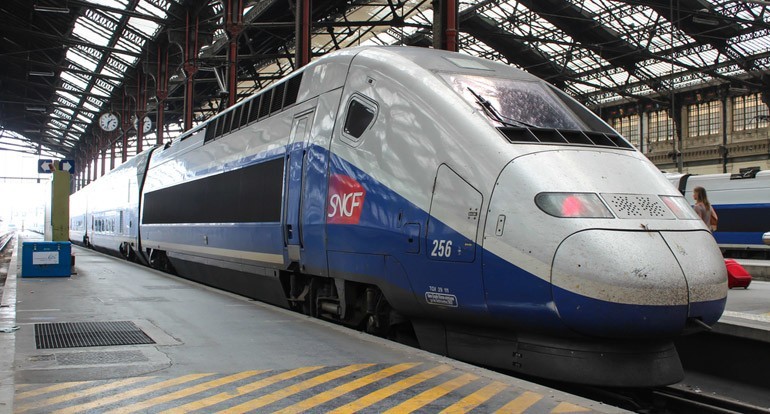
You’ve probably heard about TGV, French high-speed trains, but you may want to know more. Here’s what we think are key information everyone (not just French) should know.
1. What’s it all about?
The TGV stands for Train à Grande Vitesse, which means high-speed train. The service is operated by France’s high-speed rail service – SNCF Voyages.
The inaugural TGV service connected Paris and Lyon in 1981, and today it connects cities across France and in adjacent countries. Aside from people, TGV is also used the by French Post Office to carry mail between Paris, Lyon and Provence.
TGV trains are made by Alstom, which is headquartered in Levallois-Perret, France.
2. Speed
A TGV train set the record for the fastest wheeled train, reaching 574.8 km/h (357.2 mph).
As of mid 2011, TGV trains operate at the highest speeds in conventional train service in the world, reaching 320 km/h (200 mph) on the “LGV Est” line that connects Vaires-sur-Marne (near Paris) and Baudrecourt (near Metz and Nancy), and later Vaires-sur-Marne and Vendenheim (near Strasbourg).
3. LGV
LGV stands for “ligne à grande vitesse,” meaning high-speed line which is usually used by high-speed trains, only. France’s LGV network has around 2,037 km with three lines under construction. You can group all lines into four routes radiating from Paris: South-West, North, East and South-East. Additionally, the LGV Interconnexion Est connects the LGV Sud-Est to the LGV Nord around Paris, and the LGV Rhin-Rhône (under construction) will connect Strasbourg and Lyon.
4. TGV outside France
Aside from France, TGV technology is also adopted in other countries, including Spain, Belgium, the Netherlands, Germany, South Korea, United Kingdom and the United States (Acela Express – in cooperation with Bombardier). There are also plans for delivering TGV in Morocco, Argentina and Italy.
The Eurostar train that connects Paris and London under the English channel (la Manche) is essentially a long TGV, modified for use in the United Kingdom and in the Channel Tunnel. It comes with a smaller cross section to fit within the constrictive British loading gauge, British-designed asynchronous traction motors and extensive fireproofing.
5. Safety
TGV trains are safe – there is not a single recorded fatality due to accident while running at high speed. However, there were fatal accidents when TGVs were running on classic rails, when they are exposed to the same dangers as normal trains (i.e. level crossings).
6. The future

AGV (automotrice à grande vitesse – high speed multiple unit or high-speed self-propelled carriage) is the next step in evolution of TGV. The difference is that the AGV design has motors under each carriage and can therefore increase the capacity of TGVs by 10%. Siemens’ Velaro and Japan’s Shinkansen trains already use the multipoint technology. Alstom says that AGV weighs less than its rivals, reducing power consumption by up to 30% (than previous TGV designs).
And that wraps our introduction to TGV. Make sure to also read our “general article” on high-speed trains from here.
