
 Marc Serafino

Cryptocurrencies have yet to reach the mainstream consumer, but that doesn’t stop mainstream hardware companies from reaping big rewards from the techies engaged in the nascent industry.
Today, we bring you the story involving the trio of hardware makers — Asus, AMD and NVidia — and how they grow from and prepare for the emerging blockchain-powered industry. Here’s what we’ve got…
Asus’ motherboard for miners
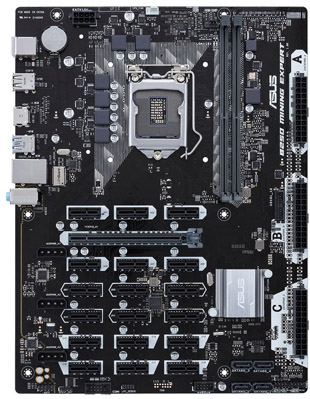 First, we have computer hardware maker Asus, which has recently announced a new motherboard with features geared specifically toward cryptocurrency miners.
Called the B250 Mining Expert, the board was unveiled over the weekend by Asus’ Republic of Gamers. It comes with a total of 19 PCI-Express expansion slots, compared to 6-12 slots featured on competitors’ products, to enable miners to run as a many graphics cards as possible.
These slots are further split into three groups, each containing 24 dedicated pins, to allow the mining rig to be connected to three power supply units at once, stabilizing the rig for multi-GPU usage. In addition, the board also comes with a few other features miners will love, including live visual statistics.
Unfortunately though, the Taiwanese company failed to mention release date and pricing information for its new board, leaving us to wait for another week or so to get that data.
Related to Asus’ crypto-endeavors, the company has also recently began rolling out GPUs designed specifically with crypto-miners in mind.
AMD’s software for blockchain computing
Second news comes from Advanced Micro Devices (AMD), which in the “cryptocurrency world” is best known for its powerful graphic cards.
 The company has recently launched a beta version of its new Radeon Software Crimson ReLive Edition Beta for Blockchain Compute graphics card driver.
Said driver promises to boost performance for “Blockchain Compute Workloads” to further bolster the efficiency of digital currency mining computers that use GPUs from the Radeon HD 7700 series for mining. It can be installed on 64-bit Windows 7 and 64-bit Windows 10 systems.
The beta software is designed to resolve an issue related to the directed acyclic graph (DAG) size and not to bolster gaming performance.
Early results are promising, with TechPowerUp reporting an 81 percent increase in the hashrate when mining DAG 199 using the new software as compared to the old driver, the AMD Radeon RX Vega 64 8GB (1546 MHz/945 MHz). And similar results can be found on Reddit.
Nvidia’s GPU division keeps growing
Finally, we have Nvidia’s story that doesn’t include any new product, but the bullish outlook for the company that (like AMD) rides the “cryptocurrency wave.”
 In a recent interview to VentureBeat, the company’s CEO Jen-Hsun Huang struck a bullish tone about the prospects for selling to miners. “Cryptocurrency and blockchain are here to stay. Over time, it will become quite large,” he said. “It is very clear that new currencies will come to market. It’s clear the GPU is fantastic at cryptography. The GPU is really quite well positioned.”
Nvidia’s CFO Colette Kress echoed those remarks, citing rising values in the global cryptocurrency market as a primary driver for GPU sales. “The recent rise in crypto coin prices resulted in increased demand in OEM GPU sales,” she added.
Cryptocurrency miners use GPUs to add new transaction blocks to a blockchain and receive newly minted coins as reward. GPUs are used to mine cryptocurrencies like Ethereum and Litecoin that use the “scrypt” hashing algorithm. In contrast, Bitcoin is chiefly mined today using dedicated hardware called ASICs.
