
 Kelly Robertson
“Who are Bitcoin users” is one of those million dollar questions. It used to be that the majority of them are young and relatively well off, living in the United States.
That at least was the result of multiple surveys of Bitcoin users from a few years before, but today the landscape is very different with Europe and Asia gaining traction, big time. At the same time, the number of users in the U.S. has also skyrocketed, and these days we also have many other cryptocurrencies, not just Bitcoin, to choose from.
Here’s how a Bitcoin user “looks like” based on surveys from 2013-2015:

The problem with any survey is that the data is collected on a voluntary basis, with only those who agree to participate getting to shape the research. This in turn makes these sort of surveys biased as no real random sample can be selected.
What about Bitcoin ATMs which seem to be popping up like mushrooms these days? Can they tell us something about who uses cryptocurrencies? Keep reading to find out…
Bitcoin ATM data
In contrast to survey data, we have Bitcoin ATM data, which shows us where users of these machines live in, presuming their operators/owners have installed ATMs to make money out of them — otherwise they would be removed from those locations.
This data comes from coinatmradar.com, which has mapped ATM locations and status since 2014; it currently counts almost 1,500 Bitcoin ATMs all around the world, 65 percent of which are installed in the United States.
As expected, ATMs are installed in high traffic venues, such as gas stations, restaurants, pizzerias, cafes, shopping malls, food stores, supermarkets, as well as so called BTC embassies that are typically offices of companies involved in the blockchain technology.
In an article for CoinTelegraph, Jennifer L. Moffitt — a privately practicing attorney from Cheyenne, Wyoming — tried to match ATM location addresses with Census tract neighborhood data (2,500-8,000 people) for income data categories of upper, middle, moderate and low. These categories, in case you wonder, are created by comparing the Estimated Median Family Income for the Census tract with the broader metropolitan area data.
And what are the results? Of the 104 ATMs in operation as early as 2014 — according to coinatmradar.com — 25 percent were in upper-income neighborhoods, while 33.7 percent were in middle-income neighborhoods, 26.9 percent in moderate income areas, and 14.4 percent in low-income tracts.
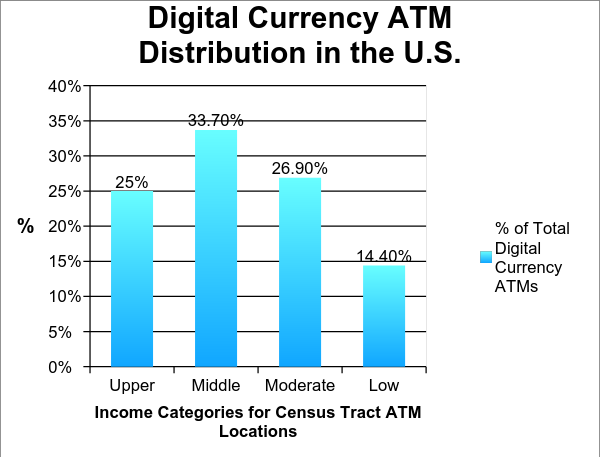
So it seems that Bitcoin users are not just the rich folks who can afford to put a part of their investment money in a new kind of (digital) asset. This could also mean that some not-rich users may be relying on Bitcoin ATMs for transferring remittances to other geographic locations, or… Right now, we can only speculate why people are resorting to using Bitcoin ATMs in the U.S. as opposed to online exchanges, though trust could be a factor.
Speaking of trust…
Can we trust this data?
No data can be trusted 100 percent. Period. Survey data we quoted before falls in that category as well, and let’s not forget what many polls predicted for the U.S. presidency.
In any case, we can trust Bitcoin ATM operators are in the business to make money, and despite the high fees these machines include, they may not be able to solely rely on the rich folks in locations served by any particular ATM. So yes, chances are that Bitcoin users are not just the rich folks, and that the cryptocurrency space has started attracting other parts of the society, as well.
We will be on the lookout for any further cryptocurrency data and get back to you as soon as we have something new to add. Stay tuned in the meantime…
Also read: How a Bitcoin ATM Works? and How To Use a Bitcoin ATM?
