
 Charles H. Miller
We have seen a number of use cases for blockchain, with a number of companies using the technology beyond the financial sector, to track things like land records, insurance, intellectual property, identity, health records and so on. But that’s just a start with new startups emerging on an almost daily basis trying to expand the use of Distributed Ledger Technology (DLT). So we guess it was just a matter of time when we would see…
Blockchain farming
The project was envisioned by an ex-banker at Wells Fargo and a former executive at Nasdaq, Raja Ramachandran and Phil Harris, who met in 2005 after Citigroup acquired electronic trading company Lava Trading. The two remained friends, and after some time decided to leave finance to start Ripe.io, which uses blockchain in agriculture with plans to weave it through the food supply chain.
“We left financial services to find a more meaningful application of blockchain. We knew it was going to be profound,” Harris told Bloomberg news with Ramachandran adding they “stumbled on food.”
The first pilot project was envisioned on Ward’s Berry Farm, a 180-acre farm southwest of Boston, where the fields overflow with carrots, baby beets, bok choy, chard, kale, cabbage, sweet potatoes, onions, radishes, fava beans, squash, pumpkins and zinnias, which are kept in rotation.
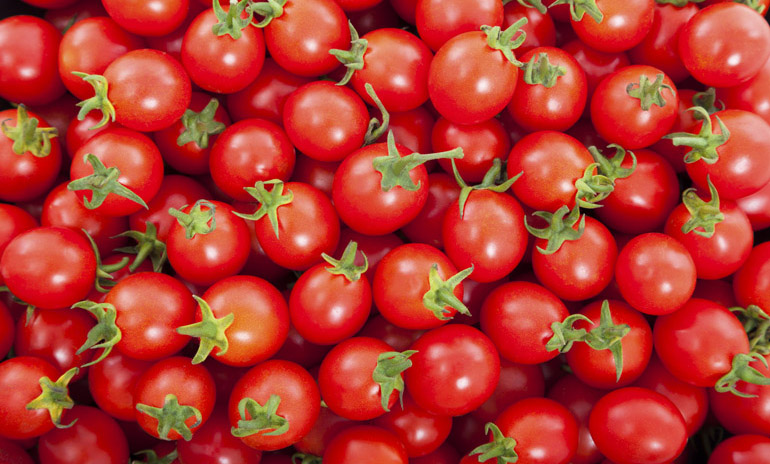
And then, they added tomatoes with the idea to track their ripeness, color and sugar content to reduce spoilage and document the supply chain.
It’s all about controlling variables
“My job is to gain control of as many variables as I can,” Ward said standing in a field of vines studded with sensors connected to a solar-powered device that routes information to the cloud-based service.
Ripe partnered with farm-to-counter salad franchise Sweetgreen to demonstrate how blockchain can be used to track crops, yielding higher-quality produce and putting better information in the hands of farmers, food distributors and restaurants. As a result, Sweetgreen is now tracking tomatoes in salads sold at its Prudential Center location in Boston.
IBM is also vested in this space and has partnered with such giants as Dole Food, Nestle, Unilever and Wal-Mart in an effort to add blockchain to their businesses. The Big Blue claims its technology can show where produce came from in seconds, whereas traditional methods can take up to a week.
Tracking blockchain tomatoes
Back to the Ward’s farm, which wanted to test whether the same principle could work for boutique restaurants committed to knowing the origins of all of their ingredients. For that endeavor, Ripe used sensors from Analog Devices and Blustream, and taste tested tracked against “normal” tomatoes.
The pilot included 200 tomatoes on 20 different plants, in red Sweet 100 and orange Sungold varieties, in both early and late-season fields. Sensors recorded environmental factors including light, humidity and air temperature. In addition, an app-connected device was used to track each tomato’s salt and sugar content as well as pH levels to assign them a “quality factor.” And like that’s not enough, tomatoes loaded onto trucks for distribution were kept tracking for humidity.
Is blockchain really needed?
Some people think that a regular database could do the “trick” and that there is no need for more complex systems.
According to Charles Cascarilla, CEO and co-founder of Paxos — which provides blockchain-based solutions to financial institutions — blockchain isn’t an immediate cure-all.
“It’s a tool, and you have to apply it to the right set of problems,” he said. “What it tends to be very good for is knowing who owns what and when. It’s not a magic bullet.”
Nonetheless, a blockchain-based system brings a new level of quality control, one that is more transparent to the tomato buyers, and for that matter — buyers of all other produce. Also, it could be used to prove where an agricultural product came from, which is essential with some products, like champagnes for which the user wants to know it really comes from Champagne, France rather than — say — Vidalia, Georgia.
For what it matters, Ripe has still to make any money from its technology. In the meantime, Sweetgreen likes the idea, adding that something like that could be applied to all kinds of produce, seasons and farms.
“We’re still drawing the maps and laying the foundation,” the company’s co-founder Jonathan Neman said.
