
 Charles H. Miller
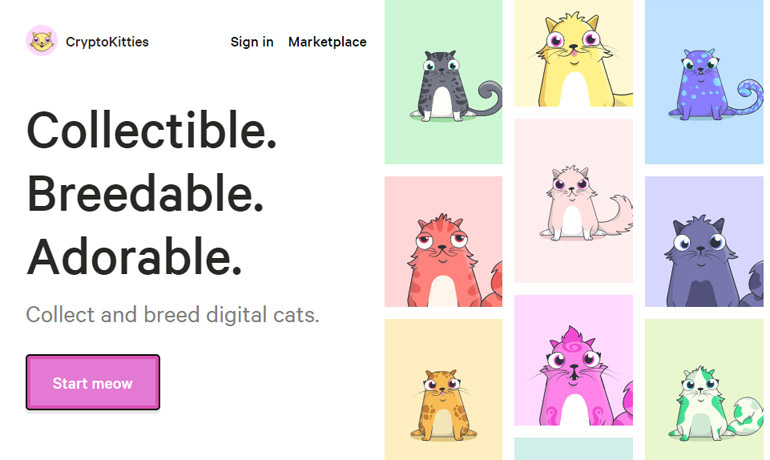
You may have heard about it — if not, now’s your chance — CryptoKitties is taking the Ethereum world by the storm.
Like that is the case with “regular,” centralized internet, decentralized internet — some would argue — is also getting “all about cats,” though not cat videos, at least not for the moment. As I’m writing this, more than $10 million has been spent on cute digital cats through CryptoKitties, which obviously deserves our attention.
What’s CryptoKitties all about?
CryptoKitties is the Ethereum-based digital kitten collectibles game, with each digital kitten representing a unique crypto asset and the ownership of it cannot be altered, as it is integrated onto the Ethereum blockchain.
Anyone within the Ethereum network can purchase and then sell (for ether) breedable cartoon kittens, with the underlying technology (blockchain) preventing the alteration of ownership or production of fraudulent kittens. This in turn provides value to the kittens as collectibles with scarcity and rarity.
Like that is still the case with most cryptocurrencies, there is no intrinsic value behind digital kittens. That, however, hasn’t stopped the global cryptocurrency community from embracing the platform to get these cartoon kitties, quite the contrary.
“The future is exciting. And we believe that Blockchain is the future — but Blockchain is about as approachable as a bunch of ones and zeroes,” the CryptoKitties team said. “We want a future for everyone, not one exclusive to Bitcoin miners, VCs, ICOs, and other equally fun acronyms.”
Some expensive kitties
Five of the rarest digital kittens on the CryptoKitties platform were sold for over $100,000 each, and yes — we gotta wonder what’s the reason for anyone spending such money on a digital asset which is not a currency, no matter how cute it may be.
But again, that hasn’t stopped CryptoKitties from becoming the largest Ethereum-based app. It has even surpassed the major decentralized cryptocurrency exchange EtherDelta to become the largest application on the Ethereum protocol by gas consumption.
According to ETH Gas Station, the CryptoKitties Ethereum smart contract accounted for 13.94 percent of Ethereum’s transaction volume over the last 1,500 blocks.
No such thing as intrinsic value
You may think that because these digital kitties don’t have intrinsic value, they won’t succeed in the long term. Ethereum co-founder Vitalik Buterin bares to disagree, providing the auction of Leonardo Da Vinci’s Salvator Mundi as an example.
Said painting was auctioned off to a Saudi price at $450 million, by Christie’s. The painting could represent $450 million in value to Saudi Prince Bader bin Abdullah bin Mohammed bin Farhan Al Saud, but to others – the painting may not be worth as much.
He added that CryptoKitties illustrates very well that the “value of a Blockchain extends far beyond applications that would literally get shut down by banks or governments if they did not use one.”
As for the value of the digital kittens on the CryptoKitties platform, it is based on rarity and scarcity, like every other cryptocurrency in the market with a fixed monetary supply.
But is it really a decentralized app?
Some critics have pointed out that these kitties aren’t as decentralized as one would think. They added that nothing stops the owner of the CryptoKitties smart contract, Kitty Core, from editing the algorithm and mutating a kitty against the will of its owner.
“Did you read the cryptokitty contract?” A bitcoin developer Udi Wertheimer wrote on Twitter. “Ownership can change, owners can shut down the system at any time, and replace the contract arbitrarily.”
The game is run within a centralized database, and mostly operates from the CryptoKitties website.
Also, while the majority of the CryptoKitties code is open source, there are a few commands that have been kept hidden, including the genetic algorithm that creates the kittens.
Personally, we think this is the way dapps must run. Completely relying on Ethereum’s blockchain to run the app is next to impossible, at least when it comes to user experience.
Adding to that sentiment, the Kitty Corp reflected on the issue: “Completely decentralizing CryptoKitties would have resulted in a game that wasn’t as fun, and we would have crippled our efforts to bringing blockchain to the masses.”
Is CryptoKitties sustainable?
CryptoKitties’ growth rate has increased to a point in which it had led to an Ethereum network congestion. This in turn has prompted the company to increase the birthing fee from 0.001 ETH to 0.002 ETH.
“This will ensure your kittens are born on time! The extra is needed to incentivize miners to add birthing txs to the chain. Long-term solution will be explored very soon,” CryptoKitties said on December 4th.
For the time being, the first decentralized game on Ethereum blockchain seems sustainable, and developers in the traditional gaming industry could explore and evaluate its success to copy parts that matter (to them).
What’s more, the company has demonstrated frictionless international trading of digital assets on a blockchain at a large-scale. And if the CryptoKitties platform is evaluated as a peer-to-peer digital assets exchange, the technology’s use case becomes more intriguing than a simple collectibles game.
Long-term, investors and traders will be able to exchange digital assets using dapps on the Ethereum network. And that’s the future worth looking for.
